[DSA] Binary Heaps, Priority Queue
![[DSA] Binary Heaps, Priority Queue](https://cdn.hashnode.com/res/hashnode/image/upload/v1742485138726/04c206f5-8534-4345-9400-e5da61cda6dc.png)
Binary Heaps
Giới thiệu
Binary heaps giống là complete binary tree (là cây nhị phân được điền đầy đủ ở tất cả các mức từ trái sang phải, ngoài trừ có thể mức cuối cùng), nó có một số tính chất sau:
Max Heap: các node cha luôn lớn hơn node con.
Min Heap: các node cha nhỏ hơn node con.
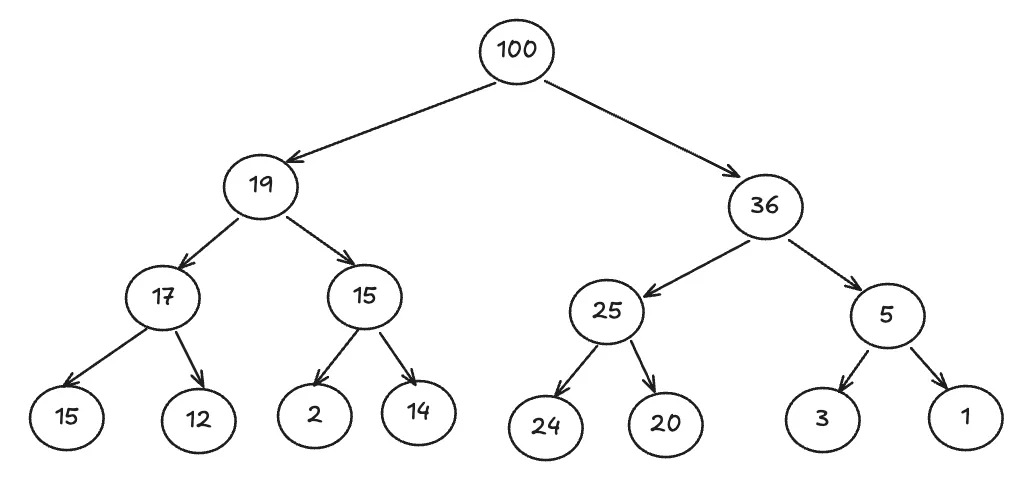
Binary Heap có thể được biểu diễn dưới dạng array như sau:

Cách xác index của các node cha và con trong 1 array độ như sau:
Nếu 1 node nằm index n:
Node con bên trái được lưu ở vị trí: 2n + 1
Node con bên phải: 2n + 2
Vị trí của node cha nếu node con nằm ở index n (làm tròn xuống): (n-1)/2
Khởi tạo
class MaxBinaryHeap {
  values;
  constructor() {
    this.values = [];
  }

  insert(element) {}

  bubbleUp() {}

  extractMax() {}

  sinkDown() {}
}
Khởi tạo các method
insert
  insert(element) {
    this.values.push(element);
    this.bubbleUp();
  }

  bubbleUp() {
    let idx = this.values?.length - 1;
    let element = this.values[idx];
    while (idx > 0) {
      const parentIdx = Math.floor((idx - 1) / 2);
      const parentElement = this.values[parentIdx];
      if (element < parentElement) break;
      this.values[idx] = parentElement;
      this.values[parentIdx] = element;
      idx = parentIdx;
    }
  }
extractMax
Trả về giá trị gốc (lớn nhất) → Thay giá trị gốc bằng phần tử cuối cùng của Heap → Sắp xếp lại heap cho đúng.
  extractMax() {
    const max = this.values[0];
    const end = this.values.pop();
    this.values[0] = end;

    this.sinkDown();

    return max;
  }

  sinkDown() {
    let idx = 0;
    let element = this.values[idx];
    const length = this.values.length;

    while (true) {
      element = this.values[idx];

      const leftChildIndx = 2 * idx + 1;
      const rightChildIndx = 2 * idx + 2;
      const leftChildElement = this.values[leftChildIndx];
      const rightChildElement = this.values[rightChildIndx];

      let swap = null;

      if (leftChildIndx < length) {
        if (leftChildElement > element) {
          swap = leftChildIndx;
        }
      }

      if (rightChildIndx < length) {
        if (
          (rightChildElement > element && !swap) ||
          (swap && rightChildElement > leftChildElement)
        ) {
          swap = rightChildIndx;
        }
      }

      if (!swap) break;
      this.values[idx] = this.values[swap];
      this.values[swap] = element;
      idx = swap;
    }
  }
Độ phức tạp
| Method | Big O |
| Insertion | O(log N) |
| Removal | O(log N) |
| Search | O(N) |
Priority Queue
Là kiểu dữ liệu giống queue nhưng được sắp xếp dựa vào độ ưu tiên.
Ở đây ta sẽ sử dụng Binary Heap để xây dựng Priority Queue
Khởi tạo
class PriorityQueueNode {
  value;
  priority;
  constructor(value, priority) {
    this.value = value;
    this.priority = priority;
  }
}

class PriorityQueue {
  values: PriorityQueueNode[];
  constructor() {
    this.values = [];
  }

  enqueue(value, priority) {}

  bubbleUp() {}

  dequeue() {}

  sinkDown() {}
}
Khởi tạo các method
enqueue
  enqueue(value, priority) {
    const newNode = new PriorityQueueNode(value, priority);
    this.values.push(newNode);
    this.bubbleUp();
  }

  bubbleUp() {
    let idx = this.values?.length - 1;
    let element = this.values[idx];
    while (idx > 0) {
      const parentIdx = Math.floor((idx - 1) / 2);
      const parentElement = this.values[parentIdx];
      if (element.priority < parentElement.priority) break;
      this.values[idx] = parentElement;
      this.values[parentIdx] = element;
      idx = parentIdx;
    }
  }
dequeue
  dequeue() {
    const max = this.values[0];
    const end = this.values.pop();
    this.values[0] = end;

    this.sinkDown();

    return max;
  }

  sinkDown() {
    let idx = 0;
    let element = this.values[idx];
    const length = this.values.length;

    while (true) {
      const leftChildIndx = 2 * idx + 1;
      const rightChildIndx = 2 * idx + 2;
      element = this.values[idx];
      const leftChildElement = this.values[leftChildIndx];
      const rightChildElement = this.values[rightChildIndx];
      let swap = null;

      if (leftChildIndx < length) {
        if (leftChildElement.priority > element.priority) {
          swap = leftChildIndx;
        }
      }

      if (rightChildIndx < length) {
        if (
          (!swap && rightChildElement.priority > element.priority) ||
          (swap && rightChildElement.priority > leftChildElement.priority)
        ) {
          swap = rightChildIndx;
        }
      }

      if (!swap) break;
      this.values[idx] = this.values[swap];
      this.values[swap] = element;
      idx = swap;
    }
  }
![[DSA] Graph Traversal](https://cdn.hashnode.com/res/hashnode/image/upload/v1752495638510/f2d535de-1f28-4b13-b471-8f408c7a9c72.webp)
![[DSA] Graphs](https://cdn.hashnode.com/res/hashnode/image/upload/v1750257831609/5d62aebd-3cd9-4ba9-9904-4e998b46d29c.png)
![[DSA] Hash table](https://cdn.hashnode.com/res/hashnode/image/upload/v1750167172887/8856c6d8-9d16-40e4-ab4f-e1e1dd9bae31.png)
![[Terraform] Xử lý khác biệt giữa Cloud và Terraform state](https://cdn.hashnode.com/res/hashnode/image/upload/v1744814931301/b9f73c31-ad88-45ab-9e16-ed347756ae59.png)